
TULSA-PRO
TRANSURETHRAL ULTRASOUND ABLATION FOR PROSTATE CANCER AND ENLARGED PROSTATE
in San Antonio, Texas
MRI Guided
Customized treatment plan with real time imaging
Tissue Ablation
Directional thermal ultrasound to remove harmful tissues with continuous rotation without incisions
Closed-loop Feedback
Temperature controlled feedback to make the procedure as comfortable and precise as possible
What is TULSA?
TULSA-Pro is an MRI-guided and minimally-invasive procedure used to target and ablate cancerous tissues of the prostate. This is a great option to precisely eliminate harmful tissues without disrupting nearby organs. This procedure is done under general anesthesia and can be completed in less than an hour. One major benefit to this outpatient procedure is that there is minimal to no pain which leads to a speedy recovery.
Why Choose TULSA?
One of the major benefits of this procedure is that we are able to protect surrounding tissues of the urethra and rectum as well as preserve function. As this is a minimally invasive procedure, the recovery time as well as the risk of impotence and incontinence are reduced.
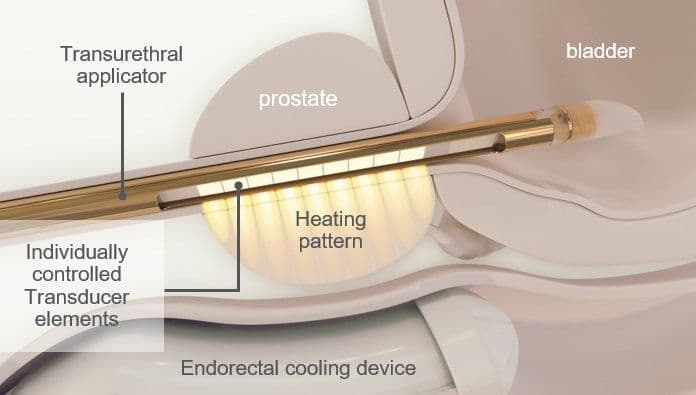
We use a device known as an ultrasound applicator that is guided through the urethra and into the prostate. The function of this device is to emit heat and break down cancerous cells. Throughout the procedure, we use an endorectal cooling device to protect nearby tissues from the ultrasound waves and preserve function.
This procedure is customized as we use live MRI imaging to pinpoint the exact location of cancerous tissues. We are able to control the direction and strength of the sound waves to efficiently ablate harmful tissues and visually confirm that the cancerous cells are no longer present.
A New Treatment for Prostate Cancer
Check out this short video from board certified urologist, Dr. Naveen Kella discussing the new prostate cancer treatment, TULSA-Pro.
How TULSA-PRO works
Watch this short video depicting a live action of the TULSA procedure from beginning to end.
TULSA Experience
Check out this short video of one of our first patients discussing his experience with TULSA-PRO.
TULSA Publications
FDA APPROVAL
PROSTATE CANCER LOCALIZATION STUDY WITH TULSA
Coming from Out of Town?
Board certified urologist, Dr. Naveen Kella is one of the nation's top prostate cancer surgeons. We have many patients from all over the country come to our office to see Dr. Kella given his experience. We can set up a virtual consultation to discuss options as well as coordinate surgery. After the surgery, you will be able to travel home the next day and you will follow-up with a local urologist to remove the catheter.
Frequently Asked Questions
Following the TULSA Procedure, you are discharged from the hospital the same day.
The procedure is performed in a single session that takes a few hours (2-4 hours). It is conducted under general anesthesia. After the procedure, Dr. Kella may decide to keep you in the hospital overnight for observation or you may go home the same day.
The TULSA Procedure uses Directional Ultrasound delivered through the urethra. This means the energy is delivered directly through the urethra (which is being cooled throughout the procedure) to the edge of the prostate. The energy does not come through the rectum, leaving the rectum preserved. In addition, TULSA has rectal cooling throughout the procedure to further protect the rectum from any unintended heat.
As with many procedures, there are side effects associated with the TULSA Procedure. The most common side effects include pain/discomfort in the targeted area, blood in urine, urinary tract infection, urinary incontinence, and erectile dysfunction. Dr. Kella will review with you all the risks associated with the TULSA Procedure.
The procedure has a code covered by Medicare. Commercial insurances vary.
The TULSA Procedure is done under general anesthesia to keep your body as still as possible within the MRI machine during the procedure. Patients may have minimal discomfort, which are manageable with over the counter medications.
A catheter is typically in place for up to 14 days. Dr. Kella will assess your voiding function to confirm the appropriate removal date.
As observed during the pivotal study, patients typically returned to their daily activities (including work) within a couple of days following the procedure, and then back to baseline urinary/bowel quality of life within three months.